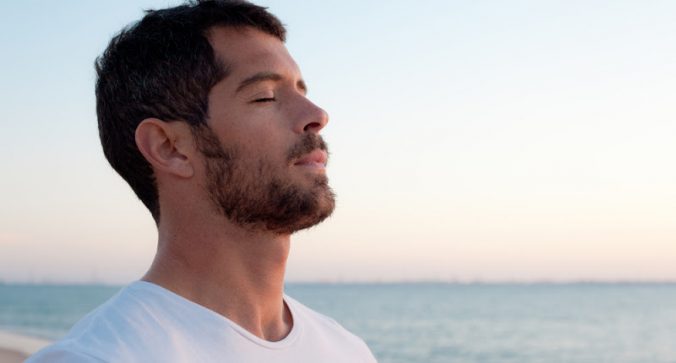
Hypnotherapy is well known for healing trauma and pain relief. Hypnosis is also extremely valuable in working with sports enhancement, weight loss, motivation, self-esteem, anxiety, panic attacks, insomnia, increased confidence, smoking, phobias and stress related issues.

Category: Breathe (Page 4 of 5)

Restructuring your Breathing to Relax

To learn to relax, you’ll need to force yourself to develop new habits, such as the way you breathe. Because one of the most common symptoms of panic is shortness of breath, you’ll want to learn to breathe differently.

Whenever you feel anxious, stop and note your breathing, then slow it down. Breathing deeply, especially with a longer exhalation, will help you relax. You can shift from the fight-or-flight response (activated by your sympathetic nervous system) to the relaxation response (activated by your parasympathetic nervous system) by using the following methods.

Hold your breath for 10 to 15 seconds. This temporarily prevents the dissipation of carbon dioxide.

Breathe in and out of a paper bag. You will re-inhale the carbon dioxide in the bag and restore the balance of oxygen and carbon dioxide in your bloodstream.

Exercise vigorously when you’re anxious. This increases your metabolism and produces more energy. The inhaled oxygen is used up by the process of metabolism, and a larger quantity of carbon dioxide will be produced.

Practice deep abdominal breathing, which allows your lungs to fill to capacity. This slows your body down.

Breathing Exercises

You can learn three different breathing exercises. Learning these will enable you to practice breathing, no matter how little time you have. Each of the following techniques can fit into available windows of time.

When you breathe too fast, the muscles in your abdomen tighten up, and your chest cavity becomes constricted. You want to reverse this by learning to breathe using a method that overemphasizes your diaphragm. This will help you remember how to breathe deeply. As you breathe abdominally, your belly rises when you inhale and drops when you exhale.

This is because the diaphragm, the large dome-shaped muscle under your rib cage, expands and contracts. When you inhale, your diaphragm contracts and pulls down, as your abdominal muscles relax. This allows your lower lungs to expand, so that you can breathe deeply. When you exhale, your diaphragm moves back up, and your abdominal muscles contract.

Breathing Exercise 1

  1. Lie on your back on a carpeted floor or bed. Put a pillow under your head and two pillows on your belly. This position allows you to watch the pillows rise as you use your diaphragm muscles to breathe. While inhaling, breathe through your nose.
  2. Now, take a deep breath and watch the pillows rise. While exhaling, watch the pillows go down.
  3. While continuing to lie on your back, set aside the pillows and put your hand on your belly. Use the breathing techniques in step 1 and notice your hand rising and falling with every inhalation and every exhalation.
  4. Still lying on your back, place your arms at your side and follow the same breathing method. Notice your belly rise and fall with each inhalation and exhalation.
  5. Now, sit on an easy chair or a sofa and watch your belly rise and fall with each inhalation and exhalation.
  6. Sit up straight, in an upright chair, and repeat this breathing method. Make sure that your shoulders and chest are still.
  7. Finally, stand up and repeat the exercise.

Set aside 15 to 20 minutes to practice Exercise 1 at least once a day. It’s best if you practice this exercise in a quiet place where you won’t be interrupted. Try to clear your mind of the day’s concerns and consider it a break.

You won’t be able to practice Exercise 1 on the spur of the moment. However, you will be able to practice an abbreviated version of it.

Breathing Exercise 2

The next exercise can be practiced sitting down and requires only a few minutes.

  1. Find a comfortable sitting position.
  2. Put both feet on the floor with your arms at your sides.
  3. Breathing in, fill your lungs with more air than you usually do.
  4. Wait a moment before you exhale.
  5. Slowly exhale more air than you think you can.
  6. Inhale again and watch your belly rise.
  7. Hold for a moment.
  8. Exhale slowly.
  9. Repeat this several times.

Breathing Exercise 3

Use this exercise to monitor your breathing throughout the day and reestablish a calming
breathing pattern.

  1. Breathe through your nose.
  2. Slow your breathing to eight to twelve breaths per minute. The slower the better.
  3. Exhale more slowly than you inhale.
  4. After breathing out, hold a moment before taking your next breath.

Try any one of these abdominal breathing exercises the next time you feel anxious. Notice how
some of your anxiety drifts away. Practice breathing on a regular basis, and do it often, so that
it becomes your habitual way of breathing. Try to stop what you are doing every hour and slow
down your breathing by breathing abdominally for at least 30 seconds.
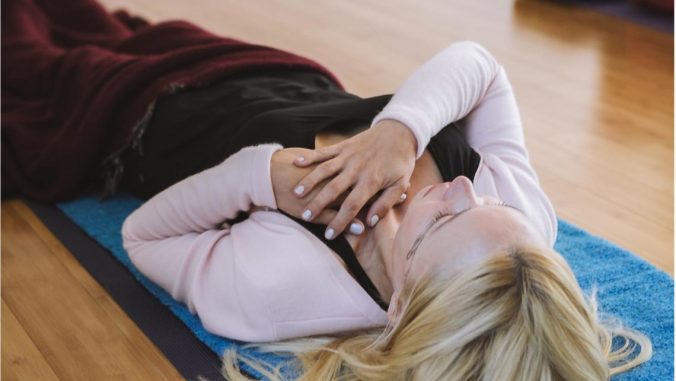
By repeatedly stimulating the vagus nerve during those long exhalations, slow breathing may shift the nervous system towards that more restful state, resulting in positive changes like a lower heart rate and lower blood pressure.

Breathwork is there to balance the Mind, Body, and Spirit

Breathwork can go beyond the yoga practice; it is a powerful therapeutic practice. It is there to benefit your mind, body, and spirit.

If you’ve ever been to a yoga class, you’ve heard an instructor remind you to control your breath. In the ancient yogic teachings, the practice of directing the breath is called Pranayama, and it teaches you to breathe consciously, with awareness, and with intent. Within the teachings, there exists many different exercises that can help you tap into your breath as a means of building self-awareness and focus during meditation or yoga.

Today, breathwork has evolved to include many new techniques that focus on the use of breathing exercises as a means of therapy and self-healing.

Breathwork is more than an exercise of breathing correctly or with intent. These breathing techniques are tools for major transformation and healing. Breathwork encompasses a broad range of whole-being therapeutic practices and exercises used to relieve mental, physical, and/or emotional tension.

Let’s find out how it can be benefit your mind, body, and spirit.

Body

When you think of breathwork, you probably think of the physical aspect of breathing – the inhaling and exhaling of air. Breathing is a vital part of life; it helps deliver oxygen into your bloodstream and remove carbon dioxide.

Completing a full breath cycle involves your whole body – your chest, belly, back, and mind. It takes effort to coordinate all elements of the breath, even though the simple process seems effortless.

The physical benefits of deep breathing are often immediate. By breathing deeply, you can activate your parasympathetic nervous system, and in turn slow down your heart rate and lower your blood pressure – creating a feeling of calm. You also rely on your diaphragm instead of your chest, inviting your neck and chest muscles to relax and engage your abs and a larger amount of oxygen to reach your body’s cells and organs.

When your body is operating under “fight-or-flight” response, or stress, it releases a surge of hormones (such as cortisol and adrenaline) that causes your breathing to speed up, increases your pulse and blood pressure, and puts you in a state of hypervigilance. Deep breathing can help reverse this response and relax your body.

Try this: Next time you practice breathwork, focus on the physical aspects of your breath:

  • Watch your chest and belly rise and fall.
  • Notice the temperature and moisture of your breath.
  • Tune into the muscles and bones moving in your body.
  • Observe how your body feels when you shift from shallow to deep breathing.

Mind

In addition to reversing the physical stress response in your body, deep breathing can also help calm and slow down the emotional turbulence in your mind. In fact, there are studies that show breathwork can help treat depression, anxiety, and PTSD.

Breathwork can help you reach a deeper state of mind. While in this state, you may be able to access buried emotions, grudges, and traumas, and ultimately release yourself from their grip on your mental state. Breathwork is often used to help those who have mental health issues and is seen as a way to calm and focus your mind.

Try this: Next time you practice breathwork, focus on your mind:

  • Be aware of the thoughts in your head, but don’t attach to them.
  • Feel what emotions come up.
  • Notice your inner voice.
  • Visualize the intention you set for your breathwork practices.

Spirit

Breathwork can also be spiritual. When you practice, you can move beyond your body and mind, and connect with your core spirit – your Self. In other words, you can remove your ego and connect to your true Self and the Universe. Many people who practice breathwork experience spiritual awakenings or attunements to their inner being.

Try this: Next time you practice breathwork, focus on the spirit:

  • Feel the universe filling you with air on your inhalation.
  • Experience the life force (prana) flow through you.
  • Allow yourself to make space for this energy within yourself.
  • Feel how this energy connects you with a deeper part of your Self.
  • As you exhale, send the energy to all the living things around you.

Styles of Breathwork
Breathwork has its roots in ancient eastern practices. Some focus more on the altered state of consciousness than others, but they all can help with self-awareness and inner peace.

The three most popular types of breathwork are:

  • Pranayama
  • Holotropic
  • Rebirthing

1. Pranayama
If you practice yoga, you will likely be familiar with this breathwork practice. Pranayama is about controlling (yama) your breath (prana) for positive effects. By controlling your breath, you can move past emotional and energetic blocks that hinder the flow of your life force. There are many different techniques you can try; here are some to begin with.

2. Holotropic
Holotropic breathwork is a practice often accompanied with intense music and led by an instructor guiding a group of participants. It involves inhaling and exhaling for the same amount of time at different speeds to induce an altered state of consciousness.

Holotropic therapy has its roots in LSD therapy but is the drug-free alternative, where the main intent is to produce mind-altering experiences. People often experience visions, uncontrollable spurts of emotions, and muscle cramps. At the end of the session, you would share your experiences with others in the group and are asked to draw a visual representation of your experience.

3. Rebirthing
Rebirthing breathwork is grounded in the idea that you carry residual stress from your traumatic experience of birth. Through this type of breathwork, it is believed you can allow yourself to release any emotional baggage and trauma that occurred during your birth.

The practice involves using circular breathing and often lying mostly underwater to create a state of relaxation that allows for pent-up stress, which has been stored in the body since birth, to be released. Through conscious breathing, instead of simply breathing air in and out, you can transform it to instead move energy.

Breathwork can go beyond the incorporation of breathing during your physical yoga flow and can be a powerful therapeutic practice.

If you decide to explore its benefits, talk to an expert in that practice and try out different styles of breathwork to find the one that best works for you.

Ref:. chopra.com

« Older posts Newer posts »