Hypnotherapy is well known for healing trauma and pain relief. Hypnosis is also extremely valuable in working with sports enhancement, weight loss, motivation, self-esteem, anxiety, panic attacks, insomnia, increased confidence, smoking, phobias and stress related issues.

Tag: Concentration (Page 3 of 4)

Hypnosis can Improve and Enhance the Quality of Life of Alzheimer’s and Dementia Clients

Alzheimer’s is the most common cause of dementia, a general term for memory loss and other cognitive abilities serious enough to interfere with daily life. Alzheimer’s disease accounts for 60 percent to 80 percent of dementia cases. Dementia is a general term for a decline in mental ability severe enough to interfere with daily life. Memory loss is an example.

Please click here to make an Appointment!


Hypnotherapy and Hypnosis has been used to improve and enhancing the quality of life for people with Alzheimer’s and Dementia.

2007 Study Results – Simon Duff, Ph.D and Daniel Nightingale, Ph.D: This pilot study explored the use of hypnosis to influence 7 aspects of quality of life in individuals with dementia: concentration, relaxation, motivation, activities of daily living, immediate memory, memory of significant events, and socialization. The results indicate that hypnosis has a beneficial impact on quality of life on both a short-term and long-term basis. Unlike the other study participants, the participants in the hypnosis group showed improvement in all 7 items – some of which were maintained over a period of time, such as 21 months or more.

The study authors hypothesize that perhaps an individual with dementia is aware of his or her gradual loss of abilities. That awareness leads to increased levels of anxiety and depression – which are known to involve active cognitive processing. Because the individual’s limited cognitive resources are being used up by anxiety and depression, even greater loss of memory, motivation and ability takes place. The authors further hypothesize that hypnosis may decrease an individual with dementia’s anxiety and depression (through positive suggestion and relaxation), which – in turn – may free up otherwise engaged resources so they are available for the individual to use to successfully accomplish cognitive tasks.

Notes: Eighteen participants were recruited from 2 care homes and were randomly allocated into 1 of 3 groups, the hypnosis group (HG), the discussion group (DG), and the treatment-as-usual group (TG). The HG received weekly individual sessions of hypnosis carried out in their single-occupancy bedrooms at their residential or nursing home. Each session lasted approximately 1 hour. Thus, over the 9-month period each HG participant received a total of 36 hours of hypnosis in 36 sessions. Prior to the first hypnosis session, each participant received 1-hour consultation and interview to customize the terminology used during the hypnosis sessions. This ensured that the language used was familiar and personalized for each participant and to ensure comprehension of suggestions that were to be used. Participants were also introduced to the process of progressive muscle relaxation. Participants were induced into hypnosis in 3 phases: (i) eye closure, (ii) progressive muscle relaxation, starting at the scalp and moving progressively down toward the feet, and (iii) a permissive induction. Permissive inductions “ask” each participant to allow oneself to become more relaxed. After deepening, the HG participants were given direct suggestions relating to the 7 items described earlier, along with additional “CRC” suggestions (Calmness, Relaxation, and Confidence). Examples of the statements are provided below.

  1. At the end of this session, and between now and the next time I see you, you will feel more relaxed and at ease, more motivated to do the things you want to do.
  2. You will have clarity of thought; you will be able to concentrate for longer periods of time.
  3. You will have fewer concerns and less feelings of anxiousness.
  4. Spending time with others will have meaning and you will want to spend time chatting with others.
  5. For each of the 7 items, all participants were rated on a 7-point scale, assessed once at the start of the study period and then at weekly intervals.

Alzheimer’s Care Today 2007; 8(4):321-331 By: Simon Duff, Ph.D., is a chartered forensic psychologist and a trained hypnotherapist, working at the Division of Clinical Psychology, University of Liverpool, and the Mersey Forensic Psychology Service, Liverpool, United Kingdom. Daniel Nightingale, Ph.D., was first trained in social work, then as a registered nurse in learning disabilities before completing a doctorate in both learning disabilities and transitional shock. He is a trained hypnotherapist and head of dementia services at Southern Cross Healthcare, The Alton Centre, Northampton, United Kingdom.

Please click here to make an Appointment!

The content in this publication is presented for informative purposes only. In no sense is this information intended to provide diagnoses or act as a substitute for the work of a qualified professional. For this we recommend that you contact a reliable specialist.

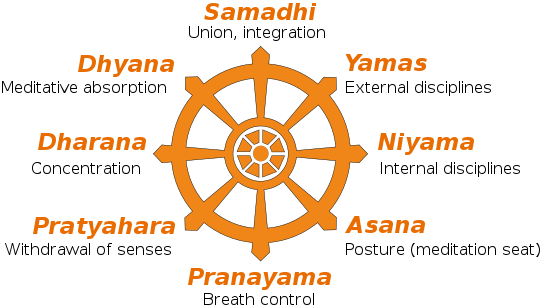
Eight Limbs of Yoga Meditation

The eight limbs of yoga are yama (abstinences), niyama (observances), asana (yoga postures), pranayama (breath control), pratyahara (withdrawal of the senses), dharana (concentration), dhyana (meditation) and samadhi (absorption).

In Patanjali’s Yoga Sutra, the eightfold path is called ashtanga, which literally means “eight limbs” (ashta=eight, anga=limb). These eight steps basically act as guidelines on how to live a meaningful and purposeful life. They serve as a prescription for moral and ethical conduct and self-discipline; they direct attention toward one’s health; and they help us to acknowledge the spiritual aspects of our nature.

1. Yama

The first limb, yama, deals with one’s ethical standards and sense of integrity, focusing on our behavior and how we conduct ourselves in life. Yamas are universal practices that relate best to what we know as the Golden Rule, “Do unto others as you would have them do unto you.”

The five yamas are:

  • Ahimsa: nonviolence
  • Satya: truthfulness
  • Asteya: nonstealing
  • Brahmacharya: continence
  • Aparigraha: noncovetousness

2. Niyama

Niyama, the second limb, has to do with self-discipline and spiritual observances. Regularly attending temple or church services, saying grace before meals, developing your own personal meditation practices, or making a habit of taking contemplative walks alone are all examples of niyamas in practice.

The five niyamas are:

  • Saucha: cleanliness
  • Samtosa: contentment
  • Tapas: heat; spiritual austerities
  • Svadhyaya: study of the sacred scriptures and of one’s self
  • Isvara pranidhana: surrender to God

3. Asana

Asanas, the postures practiced in yoga, comprise the third limb. In the yogic view, the body is a temple of spirit, the care of which is an important stage of our spiritual growth. Through the practice of asanas, we develop the habit of discipline and the ability to concentrate, both of which are necessary for meditation.

4. Pranayama

Generally translated as breath control, this fourth stage consists of techniques designed to gain mastery over the respiratory process while recognizing the connection between the breath, the mind, and the emotions. As implied by the literal translation of pranayama, “life force extension,” yogis believe that it not only rejuvenates the body but actually extends life itself. You can practice pranayama as an isolated technique (i.e., simply sitting and performing a number of breathing exercises), or integrate it into your daily hatha yoga routine.

These first four stages of Patanjali’s ashtanga yoga concentrate on refining our personalities, gaining mastery over the body, and developing an energetic awareness of ourselves, all of which prepares us for the second half of this journey, which deals with the senses, the mind, and attaining a higher state of consciousness.

5. Pratyahara

Pratyahara, the fifth limb, means withdrawal or sensory transcendence. It is during this stage that we make the conscious effort to draw our awareness away from the external world and outside stimuli. Keenly aware of, yet cultivating a detachment from, our senses, we direct our attention internally. The practice of pratyahara provides us with an opportunity to step back and take a look at ourselves. This withdrawal allows us to objectively observe our cravings: habits that are perhaps detrimental to our health and which likely interfere with our inner growth.

6. Dharana

As each stage prepares us for the next, the practice of pratyahara creates the setting for dharana, or concentration. Having relieved ourselves of outside distractions, we can now deal with the distractions of the mind itself. No easy task! In the practice of concentration, which precedes meditation, we learn how to slow down the thinking process by concentrating on a single mental object: a specific energetic center in the body, an image of a deity, or the silent repetition of a sound. We, of course, have already begun to develop our powers of concentration in the previous three stages of posture, breath control, and withdrawal of the senses. In asana and pranayama, although we pay attention to our actions, our attention travels. Our focus constantly shifts as we fine-tune the many nuances of any particular posture or breathing technique. In pratyahara we become self-observant; now, in dharana, we focus our attention on a single point. Extended periods of concentration naturally lead to meditation.

7. Dhyana

Meditation or contemplation, the seventh stage of ashtanga, is the uninterrupted flow of concentration. Although concentration (dharana) and meditation (dhyana) may appear to be one and the same, a fine line of distinction exists between these two stages. Where dharana practices one-pointed attention, dhyana is ultimately a state of being keenly aware without focus. At this stage, the mind has been quieted, and in the stillness it produces few or no thoughts at all. The strength and stamina it takes to reach this state of stillness is quite impressive. But don’t give up. While this may seem a difficult if not impossible task, remember that yoga is a process. Even though we may not attain the “picture perfect” pose, or the ideal state of consciousness, we benefit at every stage of our progress.

8. Samadhi

Patanjali describes this eighth and final stage of ashtanga, samadhi, as a state of ecstasy. At this stage, the meditator merges with his or her point of focus and transcends the Self altogether. The meditator comes to realize a profound connection to the Divine, an interconnectedness with all living things. With this realization comes the “peace that passeth all understanding”; the experience of bliss and being at one with the Universe. On the surface, this may seem to be a rather lofty, “holier than thou” kind of goal. However, if we pause to examine what we really want to get out of life, would not joy, fulfillment, and freedom somehow find their way onto our list of hopes, wishes, and desires? What Patanjali has described as the completion of the yogic path is what, deep down, all human beings aspire to: peace. We also might give some thought to the fact that this ultimate stage of yoga—enlightenment – can neither be bought nor possessed. It can only be experienced, the price of which is the continual devotion of the aspirant.

This is only a small example of the powerful message that is contained in GAIA Healing Step One of Seven.

Click Here to book your seven week GAIA Deep Healing Meditation Course.

This eight-fold path offers guidelines for a meaningful and purposeful life.

« Older posts Newer posts »