
When you practice mindfulness you then come from a place of non-judgment.
Rather than judging your thoughts and experiences as good or bad, right or wrong, hurtful or helpful, you simply observe the world around you with compassionate non-attachment.
Judgment is a thought that arises within awareness and left to its own devices, the brain will immediately begin assigning a label to thoughts and feelings.
“I’m feeling lonely. That’s bad. Loneliness makes me unlovable.”
“My friend hasn’t called me. She must not like me anymore.”
“That sales person didn’t speak to me. She is really rude.”
These assessments happen so instantaneously that our experiences are colored before we can even process them. Mindfulness is about being aware of that tendency and slowing down enough to take a fresh perspective.
It’s about bringing awareness and intentionally to the moments of our lives so we can pause to notice our feelings in a detached way. This allows us the space to reassess and see the world without our own filters.
Why Should I Practice Non-Judgmental Awareness?
You may wonder what the point of mindfulness is – why you should bother practicing awareness in the moment and why you need to observe what you are aware of without judgment.
Perhaps you see it as naive or ridiculous to avoid judging experiences that are unpleasant or negative. Loneliness does hurt. People do reject you. Salespeople can be rude.
But when you judge, you add another layer of suffering to painful events. I’m lonely, and now I feel bad about myself because I’m lonely. My friend didn’t call, and now I feel like a rejected loser because I think she doesn’t like me.
Also, when you layer judgment on top of experiences, you put a filter between yourself and the experience, watering it down and diverting your awareness from the moment.
This is true for positive and negative experiences. Once you start labeling the beautiful mountain you’re witnessing or the exquisite moment with your lover, you’ve lost part of the experience.
Does all of this make you feel like trying to twist yourself into a pretzel just to enjoy the moment?
Think about it this way: have you ever been so engaged in what you are doing that you get lost in it? Maybe it’s practicing the piano, working on a puzzle, or writing a blog post.
You aren’t thinking about whether or not the activity is good or bad, or whether you are doing it right or wrong, or when you need to have it finished. You are just doing it and enjoying the experience of doing it.
Jesus gave us the first sense of mindfulness. With mindfulness, you bring that same sense of aliveness and attentiveness to everything you do. Your thoughts aren’t wandering. You are just there – feeling it, being it, doing it, experiencing it with all of your senses and emotions.
With mindfulness you will experience this pure awareness affords an incredible sense of freedom, contentment, and inner peace. It liberates you to fully live your life.
Benefits of practicing non-judgment:
- Promotes awareness and mindfulness
- Cultivates more gratitude
- Reduces stress and worry
- Helps make wiser decisions
- Boosts productivity
- Fosters a peaceful mind
- Increases authentic self-knowledge
- Deepens expressions of love toward yourself and others
How to Stop Judging in Yoga and Meditation
In order to practice non-judgment, begin simply by recognizing judgmental thoughts or attitudes when they occur. Try labeling your judgments–positive, negative or neutral–for the next day (or even for the next hour or the next 15 minutes; you’ll be surprised by how often they surface!).
Attempt to release the emotions or opinions that you form based on these judgments. That is, practice equanimity toward each thought or situation. This isn’t the same as becoming numb or insensitive toward life, or as turning into an emotionless robot (our brains evaluate and judge for a reason!); it’s simply a practice in finding and maintaining a Sattvic state of mind.
Non-judgment in Meditation
Meditation and concentration practices are perfect settings to work with judgment, since we are already focusing on the present moment. Before your meditation, set an intention to not judge yourself for the thoughts, feelings and other distractions that will inevitably surface. Throughout your practice, instead of getting upset with the fact that you’re planning dinner, moving a tingly foot or thinking when you’re not supposed to be thinking, accept each sensation as part of the meditation process and remember that there is no such thing as a bad meditation.
Although we commonly dwell on negative judgments more than others, the same goes for positive or neutral situations. For example, if you see colors or feel waves of bliss during meditation, instead of getting excited, recognize that “good meditation” is a judgment too. Then come back to your breath.
Non-judgment in Asana
We often don’t realize how frequently we judge ourselves during a yoga practice. Next time you feel like you’re “good” or “bad” at a yoga pose, realize that these qualities are not inherent in asana. Maintaining a steady tree pose is not better than falling out of a tree pose, just as a tree in nature is no better or worse if it’s blowing in the wind; they’re simply different states of being. Similarly, stop judging yourself against others! Since our bodies are completely unique, each of us has different needs and abilities in a physical practice.
By not judging ourselves, we see that asana practice is simply about breathing through each pose and noticing how our bodies, minds, and states of being flow from practice to practice or throughout a practice. Without the veil of judgment, we create clarity to practice self-observation and self-reflection in each new moment.
Cultivating Compassion
To embrace a non-judgmental attitude, it is helpful to practice compassion towards yourself and aspects of life that you judge. The Buddhist technique of meditating on Metta, or loving-kindness, can assist in finding a non-judgmental love toward the good, the neutral and yes, the bad too.
Like all practices, not letting judgment consume our lives takes time and effort. However, the more we practice not judging in yoga, the more we’ll be able to practice in other aspects of lives. Likewise, the more we practice not judging ourselves, the more likely we are to not judge others. When we are able to appreciate everything as it is, we form a clear and balanced environment for our minds and hearts, and a larger sense of belonging in that which surrounds us. By recognizing judgmental thoughts and not to attaching to judgments, we foster acceptance and harmony in our lives, both on and off the yoga mat.

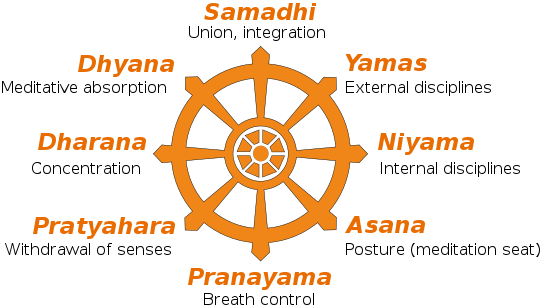 In Patanjali’s Yoga Sutra, the eightfold path is called ashtanga, which literally means “eight limbs” (ashta=eight, anga=limb). These eight steps basically act as guidelines on how to live a meaningful and purposeful life. They serve as a prescription for moral and ethical conduct and self-discipline; they direct attention toward one’s health; and they help us to acknowledge the spiritual aspects of our nature.