Hypnotherapy is well known for healing trauma and pain relief. Hypnosis is also extremely valuable in working with sports enhancement, weight loss, motivation, self-esteem, anxiety, panic attacks, insomnia, increased confidence, smoking, phobias and stress related issues.

Tag: Truth (Page 6 of 6)

When You Speak – Speak the Truth with Hypnotherapy

What do I mean when I say, “speak your truth?” It is being able to communicate your needs, ideas, boundaries and even your convictions to others without wavering and in a way that other people can hear you.

This is often done in a situation or a relationship important to you or when it feels the stakes are high.

It’s been said that the most powerful tool for physical health is a fork (or spoon) since the choices you make with it determine the good or bad things you put into your body.

In the same way, perhaps the most powerful tool for your mental health – and certainly for the health of your relationships – is your tongue.

Thousands of times each day, it (or your fingers on a keyboard: the same thing) offers the good word or the bad one out into your world.

If you say what’s true for you and say it clearly and kindly, you get one kind of result.

But if you use a sharp tongue, speak falsely, exaggerate, or leave out the parts that are most important to you, you get different results: unnecessary conflicts, lost opportunities, a tightness in your chest, etc.

Of course, the most important person to speak truth to is yourself, with inner speech.

Come to peace with the truth: the facts, your experiences and intentions, the goodness inside your heart, what’s led to what, for better or worse.

On the other hand, if you act like something is true, but deep down, there’s a knowing that it’s not – like it’s OK not to go after an important dream or that you can keep putting off dealing with a health issue such as smoking, or that everything’s fine in a cool and distant marriage – you’re living on thin ice: hard to build a good life on that foundation.

Truth is bedrock. Even if you wish the truth were different, it’s what you can count on in a world full of selling, spin, and BS. It’s your refuge.

The Practice

Speaking truly does not mean saying everything.

You can cut to the chase in a conversation, not burden a child with more than he or she can understand, be civil when you’re angry, and not spill your guts in a meeting.

Nor should you confide more than is appropriate.

There’s a place for privacy, for not telling A everything you know about B, and for recognizing how intimately you can safely communicate in a particular situation or relationship.

Speaking truly – to yourself and to others – does mean being authentic.

Is your outer expression lined up with your inner experience? Most of us have “that thing,” which is hard to express. For me growing up, it was feeling inadequate.

For many men, it’s feelings of fear or weakness.

For many women, it’s feelings of anger or power.

Could you find appropriate ways to say your whole truth, whatever it is?

Ask yourself: “What am I actually experiencing?” Relax your face completely and look at it in the mirror: What does it tell you? What does it say you really need these days?

Also, ask yourself: “What’s important that’s not getting named?” This applies both to you and to others.

Consider the hurt or anxiety beneath irritation or the rights or needs that are the real stakes on the table. Is there an elephant in the room that no one is mentioning?

Maybe someone has a problem with anger, or with drinking too much, or is simply depressed. Maybe someone’s jumbo job – 60, 70 hours a week or more, counting commute and weekend emails – is crowding family life out to the margins.

Especially when you’re upset, watch out for distortions in the words you use.

These include leaving out the context (like getting mad at a misbehaving child who’s hungry), using extreme language – words like “always” or flat statements that should be qualified – or using a tone that’s harsh or nasty.

Without talking like a robot, look for ways to be more judicious, accurate, and to the point in what you say.

Last, accept the fact that no one is a perfect communicator.

You’re always going to leave something out, and that’s OK. You have to give conversations room to breathe without continually judging yourself as to whether you’re speaking truly!

Communicating is repairing. As long as you come with basic sincerity and goodwill, your words will weave and mend a tapestry of truth in all your relationships.
 

Identifying Your Core Values

Your Personal values are the general expression of what is most important for you. A value expresses the worth of something, and in this case what you categorical like and dislike.

Please click here to make an Appointment!

We will focus on Cognitive Behavioural Therapy.

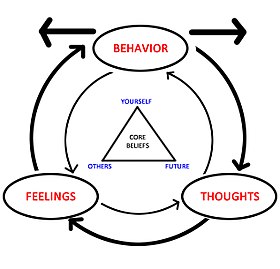
(CBT) is a short-term, goal-oriented psychotherapy treatment that takes a hands-on, practical approach to problem-solving. We will focus on how emotions, thoughts, and behaviors all influence each other according to CBT. All humans’ core beliefs can be summed up in three categories: self, others, future.

So they are like categories for all your preferences in life. Values are formed starting in early childhood and are later consciously re-evaluated and can therefore be changed.

By comparing two values you can discover which is representing something that is more important than the other. Therefore you rate the one value over the other.

Personal values are generally operating in the background. They influence everything what you do but usually it happens on auto-pilot. You just know intuitively what you like and dislike and decide accordingly.

Why is it Good to Know Your Personal Values?

The answer is twofold:

First you get clarity and build your self-awareness by identifying your values and secondly knowing your highest values can act like a guide for you. It makes intelligent decisions easier. Also knowing your negative values, those from which you try to keep away from, is very helpful as well. When you are clearly aware of your value hierarchy you can consciously check situations against your value-system, which will create better decisions and results. It will be easier to keep your balance in life.

For instance when you are about to make an important decision you can double-check if going the one or the other way would go against one of your core values. On the long run, that would pose a problem for you.

So all in all it’s an awareness building process which can give you direction in life.

When choosing your personal core values it is important to think about the criteria that you will use to make your selection. Since your personal values decision will have multiple answers, your criteria will also help you to prioritize and limit your list. Using our decision making model, you will want to look at other connected decisions for goals/source requirements that will influence your criteria. If you have already made decisions for a personal vision, mission statement, and/or core beliefs, you should see goals/source requirements that will influence the criteria for this decision.

With your connected decisions in mind, here are some criteria that might help in selecting your personal core values.

  • Consistent with my personal vision, mission, and core beliefs – In addition to specific goals/source requirements, you can use this criteria as a way to eliminate personal values that are inconsistent with your other decisions.
  • Inspirational – Personal values should encourage you to fulfill your purpose in life. Great personal values, read every day, will provide an uplift and motivation to take on the day’s challenges.
  • Unique – Your values need to speak to you. Don’t hesitate to use values learned from others, but your core values should help define who you are and want to be. They should reflect the priorities for your life and will tend to emphasize your strengths while compensating for your weaknesses.
  • Provides guidance – Personal core values should help you in your everyday decisions, particularly with relationships.
  • Long lasting – This is about creating your future. Expect that your values will evolve as you grow, mature and gain life experience. However, this is not about following the latest fad. If you expect a personal core value to change next week, it likely isn’t very core.
  • Meaningful and rewarding – Values provide the measures that help us live meaningful lives that fulfill our given purpose. Living a life of meaning brings us joy.

A List of Core Values

There are a lot of value lists out there, so here are just the real core values that most people have and that differentiate a character the most. I tried to keep the list tight and avoid repetition by synonyms:

Abundance Accountability Achievement Action
Adventure Ambition Awareness Balance
Beauty Being the Best Calmness Cheerfulness
Clarity Comfort Compassion Competition
Connection Contribution Control Courage
Creativity Curiosity Determination Discipline
Effectiveness Empathy Energy Enthusiasm
Excellence Fairness Faith Fame
Family Flexibility Freedom Friendship
Fulfillment Fun Harmony Happiness
Health Honesty Honor Humility
Independence Integrity Intelligence Intimacy
Inspiration Kindness Knowledge Liveliness
Love Money Nature Passion
Peace Perfection Persistence Philanthropy
Power Respect Security Simplicity
Significance Spirituality Spontaneity Strength
Stability Success Status Teamwork
Tolerance Tradition Truth Vitality
Wealth Wisdom

Click here to see the Core Value meaning list:

Create Your Value Hierarchy

In order to create your 10 top-values do the following:

  1. Select the 10 values from the list above that you like most. (of course you can also do a Top 5 or Top 3)
  2. Start with the first in the list. Then order this by importance by comparing two values by asking: “Which one is more important to me if I had could only have one and had to compromise the second?” Remove the winner and write it on top of a new list and then continue with the remaining 6 on the old list and so on.
  3. Do this for all 10 until you have an ordered list of your top 10 values.

Here are my top 10 personal values:

  1. Truth
  2. Integrity
  3. Contribution
  4. Love
  5. Inspiration
  6. Family
  7. Fulfillment
  8. Health
  9. Creativity
  10. Success

Your value hierarchy expresses your character of course. Someone who values adventure highly is a different character as someone who values stability more. Someone who values success highly is different than someone who values family on top.

An interesting exercise is also to create your top 10 negative values, which express what you really dislike or what is totally unimportant to you.

Are Values Fixed or Can I Change Them?

By there very nature, your value-system tend to be more stable, it is your character in it’s many facettes. But single values are not static and fixed. They can change. Personal values usually change when something big happens, or when you are consciously re-evaluating your life and make a decision, based on your experiences, to change your value hierarchy.

As an example I valued diversity a lot in my first business. Later I learned by experience all the drawbacks of doing a lot at a time and now I value simplicity more.

So what when you are dissatisfied with a value you have and what to change it?

For instance you may have the top value of stability and you want to become a bit more flexible in your life. (could be the other way around as well) Changing this would work if you create experiences and enjoy them that are in alignment with the new value: flexibility in this example.

So to integrate a new value into your top-values:

  1. Create positive experiences that express this value in your life
  2. Decrease experiences that are aligned with the opposite value in your life
  3. Also working on your beliefs will make it easier to adapt to new values.

Please break your list down to TOP 5 and then to TOP 3 personal values.

What are your TOP 3 personal values?

This is my TOP 3 personal values:

  1. Integrity
  2. Truth
  3. Love

No person likes making mistakes. Having well defined personal core values helps us avoid making choices that work against who we want to be. Our values become a clear set of guidelines for our words and actions, consistently moving us in the direction aligned with our core beliefs and personal vision. Our life becomes one of our choosing, not one that is directed by the decisions of others. Our values help us build and maintain our identity as unique individuals.

Choosing and knowing your values can provide a number of benefits that include:

  • Reducing stress
  • Making better decisions
  • Finding environments and people that support your aspirations
  • Increasing joy and happiness
  • Supporting your growth and development
  • Helping in times of conflict or confusion
  • Growing contribution and value
  • Providing motivation

Knowing it or not, choosing it or not, all of us have a set of personal core values. Prevent discontent, conflict, frustration and lack of fulfillment by choosing consciously the values by which you want to live.


Now do the limpness test: Ask yourself the four following questions?

  1. Would you sacrifice any of theses vales for a million rand?
  2. Have you lost any of theses core values in times of stress?
  3. In 20 years would theses values still hold true?
  4. Are you prepare to disregard one or more of theses values if they put you at a disadvantage?

Aligning with your core values all the time makes you powerful.

Ref:. www.myrkothum.com/personal-values/

and www.decision-making-solutions.com/personal_core_values.html

Please click here to make an Appointment!

Newer posts »

Live Hypnotherapy Sessions - 7 Days a Week – 10:00, 12:00 and 14:00. Tel: 0027 – (0)87 379 7668. - Most requested hypnotherapy sessions are available for download at R450 per download.

X
Social media & sharing icons powered by UltimatelySocial
BOOK YOUR APPOINTMENT